Search This Blog

Wednesday, March 10, 2010

Adelaide Crapsey


Read more about Adelaide Crapsey

Saturday, March 6, 2010

Where the note ends

The last time I took clarinet lessons was in 1988, and it was with two good college professors who knew their stuff. More than 20 years later, I'm having the opportunity to study with a master musician, one of whose many talents is representing the sound of the clarinet to millions of television viewers. After hearing him on records since the 1970s, it was my first chance to see this guy (I haven't asked his permission to write about him so you'll have to guess) last month, where he was in the guitar player's group. I knew I was going to see a master sideman at work, but I had no idea how profound. He led the band without leading it and has an incredible musical partnership with the guitar player. Even better were his telegraphing of dynamics, harmonic cues and resonance. I can't begin to tell you what it is like to have a lesson with a master musician. Well, many people can tell a similar story I'm sure.
It's making me thing of resonance, which seems to have something to do with the origin of the sound, something you can have control over and even increase resonance.  On clarinet, it's a great thing to imagine. But strictly speaking, resonance, is how the note is ended. "Prolongation of sound by reflection or vibration of other bodies."
Nothing does this like a violin or drum, or a harp. The thing itself is vibrating, and some of those vibrations are going to be caught by the audience's eardrums. Resonance is going to happen.

 Listening to my clarinet teacher's sound on a couple of his latest CDs, there is a way to make the clarinet resonate, and he is doing it. I am hoping some of this great articulation is transferable!


I'm thinking about practicing diminuendo on clarinet. And how to make sure the note ends with resonance.

Friday, March 5, 2010

Conway NH ain't no place for the weary kind


 The Oscar nominated song takes on new meaning in Anytown, USA

A Conway New Hampshire record store owner is standing up to the economy with a message that everyone can understand. It's the Oscar nominated song "The Weary Kind."
And, a connection to the movie the song is from.
I'm on his mailing list cause I shop there and have a book room in the back.
Here's a mail he just sent:

Hi, all
I'm looking forward to this Monday's Open Mic at the library, hope you are, too! Featured performer will be Andy Davis, a seasoned storyteller, sharing his global adventures in prose. Read more about Andy here!
After Andy's performance, the mic will be open to poets & songsters of all genres.
Throughout the evening, I'd like to share with you a few personal anecdotes that relate to the movie "Crazy Heart". which may win the Oscar on Sunday Night, and is currently being shown at the Majestic Theater/Conway Cafe in Conway Village. The late guitarist/songwriter Stephen Bruton collaborated closely with T-Bone Burnett in the making of the movie, in music & inspiration. Some say Jeff Bridges character was loosely based on moment's in Stephen's life, but it's all hearsay, and could be applied to any musician who struggled to make it, then struggled to maintain. Stephen died last summer during the making of this film
Back in the 70's, living in Texas, I worked a few years at Record Town, in Fort Worth, which was owned, and is still operated, by the Bruton family. You can read a bit about it here. This store was where i became enamored with the record business, and why my record shop on Main Street exists today. Listening to the theme from the movie "The Weary Kind", I'm reminded of how true the lyrics are, how they resonant to the common man, in even these times, & in this economy, in our town.
I'd like to share my rendition of this song at the end of the open mic, and would love for anyone who feels it to join me as well. There's a great YouTube link to song, with lyrics. Bring your guitar, tambourine, marxophone (Katherine?), or just sing along! And don't forget to see the movie at the Majestic this week...Joe Quirk has even offered to provide some finger foods from the Conway Cafe to us all Monday night!.
See you there,
Harlan

Friday, February 19, 2010

Vinyl Record Musing

It seems like 1-2 million new vinyl records are sold every year....up some years and down others....and who knows how many previously owned vinyl records have changed hands. In the midst of all the arguments over which has the better sound, it's easy to forget a primary distinction.
Going back in time, people used to compare radio sound, recorded sound, and live sound. All of it was "analog," whatever that means.
Consider the vinyl record. Even though it is mass produced, the sound comes from grooves cut in the record. Compared to a CD, or mp3, or wav or wma, it IS LIVE MUSIC. The record is making that music. What happened before the record was made may have involved tape or even digital mastering, but the RECORD IS PLAYING MUSIC.
The digital file, by contrast, is re-constructing music which resides in digital code. And, it's truly amazing how this has become the primary way of listening to music. People love it, while at the same time, it has laid waste to the whole business of music distribution and live performance.
The art of the club DJ was once about the vinyl record. Now software can do just about the same thing.
Selling records since 1997, we seldom know the age or motivations of our buyers. We've been selling books the same amount of time and most years, records are more popular than books.
Records--- bulky, labor-intensive, delicate--- are a big export from the USA to other countries.
And perhaps many people play them only once.
But, the intensity of that one play experience cannot be denied. The record, the music, the effort that went into it, and its cultural significance are handy stimulants available to anyone for a dollar and up.
The most fun of records is going back in time. Most people do not realize that before the late 1940s, records were mostly documents of a performance, rather than a corporate concoction in a studio that started out with the "raw materials" of musicians playing.
Many record fans are eventually led back to the 1920s and 1930s when recording was often a game of 'catch as catch can'.
Perhaps one day digital re-creations will display their lineage of romance and culture. It's probably a matter of demographics.
One artist who worked well with the detritus of analog imagery, including records and TV, was Nam June Paik.
The vinyl record has earned its place in the fields of mass production AND art.

Wednesday, February 10, 2010

Toyota, chain saws, and war

I was going to put a picture of my Toyota and my chain saw side by side, but that's just dumb. You can guess which one prompted a visit to the "walk-in" clinic the other day.
I had been wondering about these facilities and how they advertise as sort of a convenience store for minor medical conditions, etc. As I walked in, around 9 in the morning, three people were having an office tete-a-tete around the water cooler in the reception area. They were drinking little paper funnels of water as fast as they could. They seemed to have come from the same workplace, but were surprised to see each other there.
One guy said, "last time, I had a week's notice." The girl said, "They just called me last night." Then she said, "I could sure use a beer right now."
That little encounter helped me speculate one use for the walk-in clinic. It helped me, too. Ever been to a walk-in clinic? First I was seen by an RN, who prepped me for stitches. Then came an MD, who declined to suture. Finally, an EMT, who gave me a tetanus shot.
The MD who wouldn't stitch together my palm wound said, "Chain saws are the next most dangerous thing to war."
Nice emphasis, doctor.
And, food for thought. Because he left out..... automobiles.
Having driven Toyotas since the early 1980s, I haven't lost any sleep over not being a "Chevy man" (default position in 1960s and 1970s) any more.
Others might prefer the safe haven of a Volvo or a Suburban but I drive "tin cans" because they use less fossil fuel.
Many Toyota owners are hearing about problems with this car company, voiced loudly by the current managers of General Motors--- the U.S. Government. It seems Toyota-- according to the U.S. Dept of Transportation-- was not too quick to take the blame for random acceleration of their cars.
Actually I applaud them for hesitating to put the blame on an inanimate object, considering tort reform is not happening any time soon. And, even considering that the inanimate object is of their own manufacture.
Word the wise: Internal combustion engines are the next most dangerous thing to war.
Stepping on a gas pedal is done by a human.
Lest we forget, there are not too many things a car can do by itself that are against the law. In some places, being in your front lawn without a current registration is one of them.
Most problems with cars seem to involve a driver.
I was sitting in front of an old glass-front 7-11 back in the 1980s, in a rented Ford Pinto. I was not very familiar with the car. I put it in drive instead of reverse, hit the gas, and you know the rest.
Got lucky and only broke the glass.
As busy as most drivers can be, doing things that do not contribute to driving, we are fair game for the notion of a "runaway car."
How do you tell if you have a runaway car? Perhaps if you turn off the ignition and it doesn't go off?
I had a fussy gas pedal once and I learned how to stick the tip of my foot under the pedal and pull it back.
OK, driving a car that is about to be recalled isn't for everybody. Nor is using a chain saw, even with all the necessary safety accoutrements.
Which I have now bought, by the way. Shout out to the folks at Windy Ridge in Tamworth.
And, I look forward to a real good deal on my next Toyota. Anybody got a Tundra they don't trust? I live dangerously.

Monday, January 18, 2010

Amateur on a pro stage

I've had plenty of luck, I’m just not talented. I'm suited to finding and offering items online at moneyblows books and music. I've often helped the store by playing music gigs, but the pay has gotten so minimal that my music-playing has joined the culture of "we play but don't look down on us because we have other livelihoods."

When I moved to New England at the age of 54, it was a revelation to me that music playing is divided between pros and amateurs. The point was driven home last night by the leader of the group I played with, at the Press Room in Portsmouth, NH.

There seemed to be a ritual modesty in place. The leader started out the evening with a lecture to the audience that we are a group who will play for weddings, but we mostly play for fun. When I think of playing for fun, I think Albert Ayler must have been having fun. Coltrane must have been having fun. Sun Ra must have had fun. But playing Route 66 or Girl from Ipanema for fun? Where I come from, that was for money.

I'm taken back to when playing for fun was also full of promise. There was one time when my audience actually included Bob Dylan and Joni Mitchell. T-Bone Burnett could tell you more about this. We actually had notice a week in advance it was going to happen. Every Friday and Saturday we played at the New Bluebird Night Club on Horne Street in Fort Worth. This would have been in 1975 or 76, when the Rolling Thunder Revue came through to play the Tarrant County Convention Center. Part of the Rolling Thunder Revue was J. Henry Burnett, a Fort Worth producer and performer who had just finished producing a live album at this location with Robert Ealey and the Five Careless Lovers. When I joined the band, it made more than five, so our lead guitarist, Little Junior One Hand, renamed the band Robert Ealey and the Drifting Heartbreaks. With no specific number we could also add Johnny Reno to make two saxes and others as needed.

The weekend before this happened, T-Bone Burnett sent word. That began a week of hell for me, wondering how I might contribute to making this a good diversion for T-Bone's illustrious friends. I could barely play the sax enough to stay on the Robert Ealey gig, and look who was coming to see it? The day they were supposed to come, I must have started drinking beer early, for I was plastered by the time the gig began at about 10 p.m. Surely enough after the Rolling Thunder Revue got off their Tarrant County Convention Center show, a limo with Bob and Joni somehow found its way down to Horne Street, in the Como section of Fort Worth, and the New Bluebird Night Club. They pulled up in front on the corner of Horne and Wellesley and came in while we were playing “Ill Take You There.” You could spot each of them, Bob Dylan and Joni Mitchell, by their hats.

I wished for the ghost of Willie Lee Johnson to take over my sax. He was a local guy who had played with Ray Charles for awhile and was being seen sporadically around Como and the Trinity River Bottoms in the mid-1970s. He came to the Bluebird once while I was playing. I let him borrow my tenor and during his solo he threw the sax up in the air with one hand and caught it with the other. I thought, if I lose my sax to Willie Lee Johnson, there are more expensive lessons out there in life. Because that cat could wail. He didn't drop the horn but there was a second when I thought he might. After his solo he basically passed out and a few weeks later we heard he passed for good.

The Bluebird had a motto "Everybody's Somebody at the Bluebird." Nobody was pros or amateurs. I've tried to maintain that illusion about music playing, but reality doesn't bear it out. I hosted a jazz jam for many years. As time went by the students sounded more like students and the pros were astounding. Folks like B.J. Crosby or Marchel Ivery were a regular occurrence. Over time, with fewer pros out there on live gigs, the music I've played has been taken over by students and teachers. Many teachers are also pros. Last night in Portsmouth, we announced ourselves as amateurs, "truth in packaging." None of us teach or depend on venues for our groceries. And it wasn't Willie Lee Johnson who came to mind in my sax playing. I visualized a local guy, a well known sax player, who triggers excitement around these parts by playing a lot of notes. He's a pro. I thought of him and pleasing the audience the way he does.

So, I played a lot of notes. Even amateurs can play a lot of notes!!!

Wednesday, December 16, 2009

Facebook has a bouncer now

I was bounced at the door of Facebook. All my credentials were in order but I didn't pass the intelligence test, which consists of a wizard giving two choices: "Recommended settings" and "Old settings." Accepting the recommended settings involves accepting "everyone" into my FB life, and I'm not sure I ever intended that. Accepting the "old settings" calls for a response equal in semantic complexity, and I can't remember my old settings anyway. It's like asking me to accept the results of a high school algebra test, 40 years later, without knowing what grade I got at the time, or whether the grade still stands, or whether algebra itself has changed.
I'm making too much of this, I know. But if you were bounced at the door from a nightclub and all your friends got in, you'd brood a little too.
Every now and then I will sign in and see if anything changes. I know, it's just a pass/fail test with no consequences and up til now I've failed. This has been building up... as you owners of Facebook are aware, I've lurked on my friends' pages and posted disagreeable comments a number of times. For all I know I've been unfriended a time or two but life is like that as well.
I remember waiting to get my teeth cleaned about 15 years ago when the receptionist presented me with a form. I said I would take it home and read it but she said I'd have to re-schedule if I couldn't sign it right then. It was a required form and it had to do with..... I believe "privacy" is the term that was used. Right about that time, the term "privacy" was getting its new definition, which I take to mean "universal disclosure."
Anyway, I'll keep trying to get into Facebook and maybe eventually they'll lower the bar to include people who can't remember their old settings or people who don't know what "everyone" means. If you're an "old" FB friend and you're reading this, you now know why the proprietor of moneyblows books and music hasn't been there lately.

Tuesday, December 15, 2009

Original Master Recordings by Mobile Fidelity


 The 1979 card insert in Mobile Fidelity audiophile albums included the essay "An Audiophile's Dream Come True." Disregarding that this is one of the most abused claims in our fair language, the mfsl folks discuss why this is particularly true for their products.
They trace their lineage in severe and conscientious quality control, limited supply (200,000 or fewer per release), and half-speed mastering using the original stereo master tape.
As they say, "the disc cutter turntable is driven at 16 2/3 rpm, and the master tape is played at exactly one-half the actual recorded speed. When the completed disc is played back at real time (normal 33 1/3 rpm), the program is heard as though nothing unusual had occurred, except that the musical accuracy, clarity and imaging is truly startling!" What follows is detail on headroom and compression/limiting, as well as other refinements to the mastering process.
Equally important, according to mfsl, are the plating of the master, the mother and the stampers. That's why they sent off to JVC to meet their specifications for masterings and test pressings.
Finally, mfsl used "Super Vinyl," for which they make equally "startling" claims. Best of all-- and what makes an mfsl recording worth every penny, is the manifesto of their work:
"As is evidenced, our standards for making records are quite different from those used in the commercial record industry. We are not concerned with mass-media performances or use of our records. We are only concerned with producing an exact sonic replica of the original master tape on vinyl and with how that record will perform in your listening room. The first part requires painstaking attention to minute details to make the master lacquer right; the second part is verified on our own reference equipment which is representative of the finest audio gear available in the world today."
We're thrilled to introduce some of these previously-owned rarities into our store. Just check New Arrival LP Albums.

Tuesday, November 17, 2009

Tens of thousands of vinyl records

I saw an old fashioned record feeding frenzy this past weekend, in the Tanglewood neighborhood of Fort Worth, Texas. The estate of a jazz and classical record collector was opened to all comers. Dealers or scouts from around the country must have heard about it, they were swarming all over the records. Still, thousands must have been left. I stopped by on Tuesday and the proprietors of the estate sale told me the remaining records were all donated to the Friends of the Library in a Metroplex town about 20 miles over yonder. Many fine trad, big band, and combo jazz reissues, record club issues, even Woody Herman Mars 45 rpms. Someone swept up all the 78 rpms while I was there, presumably for one "haul-away" price. I picked up a keepsake which has the name and address sticker of one Martin Williams, a Freddie Keppard single which must have once resided in that eminent scholar's collection.

Here's is a rating and review received recently by moneyblows books & music, it's interesting enough to share:

Overall Rating: Excellent

Excellent transaction experience

I have to say (as most reviewers probably do) that the vendor's name threw me when I first saw it. However, I came around quickly when I opened the narrow, sqare package that describes an LP mailer and experienced the contents. "Eydie Swings the Blues" (1957, ABC-Paramount) is a 52-year old LP, and the sound is just gorgeous. Even more impressive is the condition of the album jacket. Amazing that it all kept so well. Everything described in the Gemm entry for this album is true, and delivery was prompt to boot. I hope to do more business with Moneyblows Records in the future.

Take a moment to check out the handmade totes.

Thursday, September 3, 2009

Three passings from the world of music: Chris Connor, Ellie Greenwich, Marie Knight


Music passes in three departures this week. Ellie Greenwich of the Barry & Greenwich songwriting team, was in her late sixties. Among the hits she is known for writing are Chapel of Love and Be My Baby. She was a "Brill Building" writer, known for writing hits that would first appear on records rather in live performance. They were part of a manufacturing chain that would extend wherever there was a radio or record player. Considering it was the 1960s, many of the ears connected to those appliances belonged to teens. People still buy records from that era, and moneyblows books & music still sells them!

Jazz singer Chris Connor passed away at the age of 81. "I Miss You So" from 1956 was one of her biggest hits. Her career began singing with the bands of Claude Thornhill and Stan Kenton. She was considered in the same jazz "school" as Anita O'Day, June Christy, Chet Baker and Julie London. From the time she left the Atlantic label in 1963, her career was eclipsed by rock 'n roll. She sang with romance, feeling, and cool, using little vibrato. The album shown above, He Loves Me, He Loves Me Not, is from her Atlantic era.

Finally, Marie Knight was 89 when she passed this week. A gospel superstar since the 1940s, she worked in the rhythm & blues idiom in the 1950s, dabbled in soul in the 1960s, and returned to gospel recording in the 1970s. We have an extremely rare copy of her 1965 release, You Lie So Well / A Little Too Lonely, which has become a Northern Soul classic. It's on the Musicor label and even has similar arrangements to another artist on that label, Gene Pitney.


Sunday, August 16, 2009

Soulsville on the cover of Arts & Leisure


Should there be any doubt that history is written by the survivors, the cover story of the New York Times Arts & Leisure section affirms it today. Isaac Hayes, Otis Redding-- gone. Al Bell, still around. The cover story of the Times is on the occasion of Al Bell, former head of Stax Records, returning to Memphis as chairman of the Memphis Music Foundation, to redeem his own legacy as an executive who took Stax to both great heights and great depths.

In a book called Boogaloo, by Arthur Kempton, the author distinguishes Stax before and after Bell. "Where Jim Stewart [label founder] had seen himself as an exporter of regional crafts, Al Bell envisioned himself at the heart of a complex modern enterprise that manufactured and sold black American popular culture all over the world."

In a Hit Parader story in October 1967, Steve Cropper, a linchpin of the early Stax sound, details the painstaking process of recording which confirms the "regional crafts" phrase.

In our store, we have one of the first releases from the company that became Stax Records, a white label promo by Charles Heinz. The label was then called Satellite, and chances are you've never heard of Charles Heinz.

In its early days Stax was much better at producing than promoting, and the reason we know its artists and sound today is because people such as Jerry Wexler and Al Bell got involved. The price one pays to taste such precious fruits from a far distance, as consumers of radio and records, is that we see and read stories such as the one the Times published today.

The demise of the Stax empire was due to some bad business deals which the Times calls "complicated." It then goes on to portray Mr. Bell as essentially a bystander and a victim in the machinations.

This is what I mean by "history written by the survivors."

Many people more knowledgeable than I am can take issue with the details of this newspaper story, if they wish to. It seems apparent that Bell pushed out the white guys who created the brand, and re-branded the company with one new album, Isaac Hayes' Hot Buttered Soul. After all, the company founders had lost all their backlist masters in a contract with Jerry Wexler, so the status quo that Bell inherited had no "sweat equity." Now the label was to be marketed the same way that the former "Newport Jazz Festival" became the "Kool Jazz Festival"-- as a necessary vice for the late 1960's, early 1970's emerging urban black consumer.

From then on, the Stax Records story becomes a tale of high finance too sordid to repeat here. As the Times points out, Al Bell was acquitted by a jury. But it would be nice for the newspaper to make less of a whitewash when they are attempting to chronicle a history they don't hesitate to call "complicated."

Wednesday, August 12, 2009

November 8, 1968 One issue of LIFE Magazine, two different covers. Spinning the election?


As a daily reader of the New York Times, I’ve watched the home delivery issue get thinner and thinner, while at the same time the paper’s news stories play up conflict throughout the world. It is as if the imploding world of the mainstream media needs the planet itself to reflect its disarray. One could cynically argue that if the advertisers would come back to the print media and huckster their goods again, the world might suddenly seem a quieter place.

But desperation makes strange bedfellows. And so the front page of the New York Times Wednesday August 12, 2009, fans the flames by showing a thug waving a piece of paper, Joe McCarthy like, at Senator Arlen Spector of Pennsylvania.

At moneyblows books and music, we are constantly reminded of nothing new under the sun. By re-arranging the detritus of the 20th century—books, vinyl records, magazines, and other things—we daily affirm that tired maxim of “history repeats itself.”

From the 1930s onward, LIFE Magazine was a flagship of the Time-Life media empire, a weekly magazine with dramatic photographs that drove home many world events in dramatic pictorials. They really excelled during wars, especially with photographers such as Larry Burrows who risked life and limb--- and died in 1971 covering the war in Laos for the magazine.

But, by 1971, LIFE Magazine was a dead man walking. The phrase wasn’t used, but “pull the plug on grandma” was the thinking of its owners, and morale within the magazine’s ivory towers had never been lower.

During the election campaign of 1968— which stands as a major news year in American history— Republicans were doing the same thing they are doing now, attempting to disrupt the efforts of their opposing party. They were not going to let LBJ’s administration end the Vietnam War, and must have been worried (as they are now about Obama’s health care plan) that circumstances might favor the incumbents. They had one strong weapon: the Republican nominee for President, who would use the turmoil to turn the election in his favor.

In its issue of October 11, 1968, the failing LIFE magazine cast its lot with the man who would later disgrace the Office of the Presidency. The writer Brock Brower wrote an article headlined “A Vision of Victory at Last within Reach.” It was a happy talk with Nixon announcing his victory in advance, with nary a hint of how he was playing his “future president” card with foreign governments.

As Anna Chennault, Henry Kissinger, and John Mitchell worked behind the scenes to complicate LBJ’s efforts, the Paris peace talks were orchestrated to fail, and South Vietnamese president Thieu pulled out of the bombing halt talks. LBJ, reeling from accusations that he was trying to halt the bombing to win the election for Vice President Hubert Humphrey, realized he could not end the war while he was President. His successor Nixon publicly took the high ground while he set up the Democrats for failure.

All this is ancient history by now, until we discovered the two issues of LIFE Magazine that preceded and succeeded the election of Nixon. In the victory issue of November 15th, LIFE reported that on October 30th, the Thieu government of South Vietnam had balked at the peace talks, even though it had approved them the day before. An article called “The Bomb Halt Decision” ends with a surreal photo of three television screen close-ups on LBJ announcing the bombing halt. If a picture is worth a thousand words, these are several thousand words on the President’s Halloween speech announcing a halt to the bombing in North Vietnam. Reading the “fine print” of the article though, the reader realizes that the picture is showing an advance videotape of a speech that was never delivered. The bombing was halted, but without the cooperation of Thieu, who had been negotiating secretly with the incoming Nixon administration. American citizens would never hear the President’s announcement speech. If this is any indication how the desperate media makes its own news, we roll back one week to the issue of November 8.

We have two different LIFE Magazines with that cover date. Orangutan. And Tron.

The issues may be substantially the same, but the covers and contents pages are different in the two issues here at Moneyblows Books & Music. A 12 page photo essay by one of Life’s star photojournalists, Larry Burrows, featured a 12-year old Vietnamese “girl named Tron” who lost the lower half of her right leg to American helicopter fire. Showing the limitations of weekly journalism, the lede (or lead paragraph) of Vol. 65, No. 19 was slightly different in each issue.

In one, it read, “The U.S. and North Vietnam last week came to an agreement. Not much later, Americans went to the polls to choose a President.”

In the other issue, it said, “The U.S. agreed last week to halt all bombing of North Vietnam. Not much later, Americans went to the polls to choose a President.”

Although this article was written in the past tense, the magazine of course was prepared and distributed before the election. If you have a passing interest in deadline journalism, you know that shelf life of an article is important, so much so that a lead paragraph is designed not to be outdated if possible. And this is a tall order in weekly journalism.

Don’t know if there was a “stop the presses” or if there may be other versions of this article out there, but we have these two. Both are dated November 8, 1968.

It’s probably fair to assume that the more detailed lede came later, e.g. “The U.S. agreed last week to halt all bombing of North Vietnam.” It also hints at the fact that South Vietnam was not part of this agreement. But due to classification of documents, it would be years before Americans would discover the sickening reality that the President they’d just elected, and thought would take office in January, had already taken over foreign policy, by negotiating with South Vietnam as a candidate and promising them favors when he was in the White House.

Now we turn to the table of contents blurbs of the two issues. In the one we are calling “earlier”, the Tron story is blurbed, “The Hope of Peace: As statesmen bargain, a girl named Tron in a Vietnamese village called Andien tries to readjust to the loss of her leg.”

In the issue with the more detailed story lede, the blurb reads: “The Edge of Peace: As the U.S. and North Vietnam reach agreement, a girl named Tron….”

From the “hope of peace” to the “edge of peace”, hours or days between them, a lot was going on behind the scenes. And yet, no peace was in sight as American casualties in southeast Asia would continue to mount.

It was not enough for the desperate editors of LIFE Magazine to influence their story spin while failing to cover what was truly going on behind the scenes. They also changed the covers of the two magazine issues with the same cover date. In what we think is the earlier printing, the magazine cover shows a zoo orangutan inert and morose, with the headline: “New knowledge about wildlife reveals that Zoos Drive Animals Psycho.” It was typical of LIFE Magazine to feature articles about nature, social mores, and entertainment, in addition to politics. Knowing far in advance that this was the issue coming out before the election, I suspect this cover was prepared in advance as the “neutral” cover while the Time-Life editors and owners tried to come up with something more immortal than an inert and morose orangutan.

In fact, their second cover also featured a zoo animal—the human kind. On its own, it’s a wrenching story and one of many incredible spreads by the late photojournalist Larry Burrows. The headline read “As the bombing stops—This Girl Tron. Nguyen Thi Tron, 12, caught in the war, watches her new wooden leg being made.”

From orangutan to Tron is a speechless journey that reinforces the sad cynicism and desperate plight of a dying magazine, to wrench emotion from a still photograph as the competition, television, stole all its advertisers. Yes, it was a picture magazine, not designed for nuance. The Time-Life organization would show how it could play both sides of the fence, announcing the bombing halt while giving Nixon a poster girl for continuing the war. Typically perhaps of the profession, they cheapened themselves by using sentimentality in the service of warmongering.

America in 1968. Two covers of the same magazine. A war we eventually lost big time. Woodstock still to come.


Monday, July 20, 2009

Cronkite shills for Columbia Records

Walter Cronkite was known as a news reader and reporter, rather than commentator. We also have a record of him flacking for Columbia Records in 1958. It's on an album produced by the Columbia Records Public Relations Department, called "Hear It Now On LP: The Story of the First LP Decade on Columbia Records."

Having invented the Long Playing record, Columbia celebrated its 10th anniversary with this mighty 33 1/3 rpm disc, by making this narrative anthology hosted by another inventor, the "inventor" of the news anchor, Walter Cronkite. The 12-in. record album contains popular and classical excerpts from 1948's Oscar Levant performance of Gershwin's Rhapsody in Blue (Ormandy and Philadelphia Orchestra), all the way to 1957's Firebird Suite (Stravinsky) conducted by Leonard Bernstein with the New York Philharmonic.

This record was likely given out in limited quantities and never issued to the general public. It also includes the popular side of Columbia, from the earliest original cast albums of "Kiss Me, Kate" and "South Pacific" down to 1957 and the then-current stable of artists such as Johnny Mathis, Ray Conniff, Les Elgart and Erroll Garner. Cronkite's classic reading of the continuity script has the familiar ring of history in the making.

Wednesday, July 1, 2009

With New Haven officialdom in the news recently-- because of a U.S. Supreme Court decision-- it seems apt to revisit another notorious instance of uniformed New Haven getting in the news, on December 12, 1967.
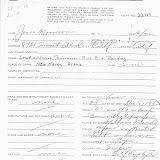


According to an article in the April 12, 1968 edition of Life Magazine,a singer/poet was in the dressing room before his concert, and he and a girl decided to adjourn elsewhere. As the singer/poet told his audience later during the concert, "And we wanted some privacy / And so we went into this shower-room / We weren't doing anything, you know, / just standing there and talking. / And then this little man came in there, / This little man, in a little blue suit / And a little blue cap, /And he said, 'Whatcha doin' there?' / 'Nothin'./ But he didn't go 'way, / He stood there / And then he reached 'round behind him / And he brought out this little black can of somethin' / Looked like shaving cream, / And then he / Sprayed it in my eyes. / I was blinded for about 30 minutes..."

After that, spoken over a drumbeat (like another Morrison sometimes did), the singer resumed his song, the famous blues tune "Back Door Man." But in the concert hall, the lights came on. Bandmate Ray Manzarek whispered to Morrison to ask the audience if it wanted them to keep playing. He did, and the response left no doubt. Quoting one of his famous songs, "When the Music's Over," the singer said "Turn out the lights!"

Suddenly, Lt. James P. Kelly, head of the New Haven Police Department's Youth Division, came on stage and arrested the singer. The singer pointed his microphone at the officer and said, "Say your thing, man."

The microphone was snatched from his hand, and more policemen rushed the stage. A well known New York Times photographer, Tim Page, was pushed into the street while taking pictures of some arrests, and he was then arrested himself, along with Yvonne Chabrier, a Life Magazine reporter, and Michael Zwerin, jazz critic for the Village Voice. In addition, according to the article, "an unknown number of teen-agers were hauled off."


Jim Morrison New Haven arrest

If you'd like more information on the band that caused this ruckus, search "The Doors" here or here. To see some pictures and the arrest documents, click on the link above: "Jim Morrison New Haven arrest."